South African mining is beginning to define itself by its possibilities rather than its constraints. Having spent much of the past decade navigating power shortages, policy uncertainty and constrained growth, the industry is focusing on what comes next. That shift was evident on the second day of the Joburg Indaba 2026, where discussion moved beyond the constraints that have long dominated the sector to the opportunities now taking shape.
Bernard Swanepoel, Chairman of Joburg Indaba, said: “Everything in our industry has to be in the context of our reality.” Having explored both the opportunities ahead and the obstacles that remained, he said the focus was shifting to the harder work of turning progress into visible results. This meant delivering affordable, dependable power and using technology and capital to improve operations. It also required developing the next generation of decision makers while sustaining investment and sharing its benefits fairly.
The day’s discussions opened with a focus on South Africa’s evolving energy landscape and its implications for mining competitiveness. Speakers noted that the debate was moving beyond power security to questions of energy strategy, investment and decarbonisation. As mines continued to invest in renewable-energy projects and self-generation capacity, the industry was taking greater control of its energy future while supporting national energy resilience.
Mike Teke, Group CEO of Seriti Resources, placed the transition in the context of South Africa’s current energy system. He noted that the country has 16 coal-fired power stations, 80% of which are in Mpumalanga. “I agree that you’re going to reach a stage where some of the coal-fired power stations are going to retire, and you’re going to find some of the coal mines are going to run out of coal. But it’s not going to be 2027, it’s not going to be 2028, and I still believe we will be mining coal in 2050.” He added: “But that doesn’t mean that we don’t recognise that climate change and global warming are among the greatest challenges that we face.”
Matthew Mflathelwa, General Manager: Strategy at Eskom said the utility’s focus was expanding beyond the transition from coal to include ways of reducing emissions from the coal-fired fleet that remains in operation, by exploring high-efficiency, low-emission technologies to reduce the environmental impact of the coal-fired fleet. At the same time, its newly launched Eskom Green business aims to accelerate utility-scale renewable-energy projects and provide large industrial customers with lower-carbon power supported by storage and other firming solutions.
From energy, the conversation moved to the changing structure of South Africa’s mining sector. A panel chaired by Bokamoso Gold CEO Billy Mawasha examined the rise of a new generation of mining companies following the withdrawal of major operators from mature assets. Panellists argued that this shift had not diminished South African mining. Instead, it had reshaped ownership and leadership while changing how capital is allocated. Assets that were once peripheral within global portfolios have become core businesses under more focused owners, creating space for smaller operators to build scale and make faster decisions.
“It takes time and consistency. It also takes discipline. But it is possible to use the platforms that have been demerged, divested or created to build proud South African mining champions that can compete globally again,” said Deon Smith, CFO of Thungela.
The discussion challenged historic assumptions about scale and success. Smaller, more agile companies are becoming important drivers of investment and employment while supporting wider sector growth.
Manganese Metal Company COO Teheli Morabe said leaner structures had strengthened decision-making. “You don’t have too many layers to pass things through. You are sometimes literally a phone call away from a discussion or consultation, or a decision. That gives you agility and has made a big difference to our decision-making.” He added that independent ownership could preserve and grow mining assets.
“I can say with a lot of certainty that if the owners had not taken on MMC at the time, MMC would have been closed by now. The grit of the teams you have is what keeps the smaller players in the game.”
Panellists on technology and artificial intelligence argued that operational excellence and digital innovation have become inseparable.
Speakers described a future mine shaped by automation and data analytics. Artificial intelligence and advanced process optimisation would also play a growing role. The result, they said, should be operations that are safer, smarter and better connected.
However, the consensus was that technology alone is not a silver bullet. Real value will come from practical implementation supported by workforce development and clear strategic objectives.
AI is already delivering benefits in exploration and maintenance planning and supporting operational decision-making. Speakers cautioned that strong governance and cybersecurity will be critical. Responsible implementation must ensure that the technology enhances long-term value rather than disrupting it.
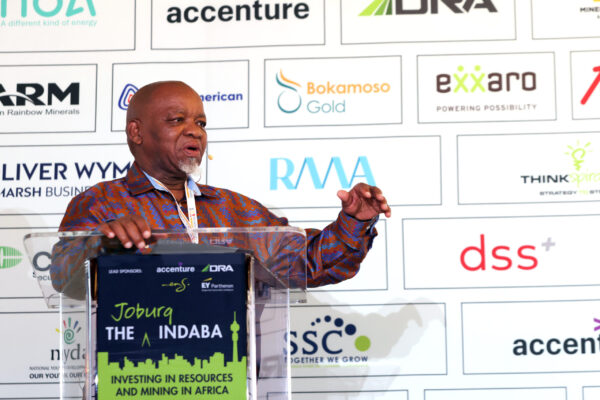
Closing the event, South Africa’s Minister of Mineral and Petroleum Resources, Gwede Mantashe, turned the discussion back to the foundations of long-term growth. He reiterated four priorities: increasing exploration, adding value closer to the point of production, investing in skills and diversifying export markets.
On exploration, Mantashe highlighted the Emerging Exploration Fund and called on established mining companies to partner with emerging explorers. He also called for more value addition within South Africa. Exporting raw commodities, he argued, also exports jobs and the economic value that could be created locally.
Linking these domestic priorities to a more uncertain global environment, he said geopolitical shifts showed that the industry could not rely on a single market. Diversifying markets would therefore be essential to protecting growth and strengthening the sector’s resilience.
Mantashe also called on the industry to become more gender-inclusive and to create clearer pathways for women to progress into senior roles. He described the employment of women in mining as the result of a long campaign for change. “I love it when I see a woman progressing through the ranks,” he said. Such progress, he added, is a key indicator of how the industry is changing.
One observation from Mantashe’s remarks stood out for capturing the scale of the shift under way: “Old is dying and new is emerging. The industry is really changing.”
What emerges in its place will depend less on rhetoric than on the quality of the decisions that are being made now.