


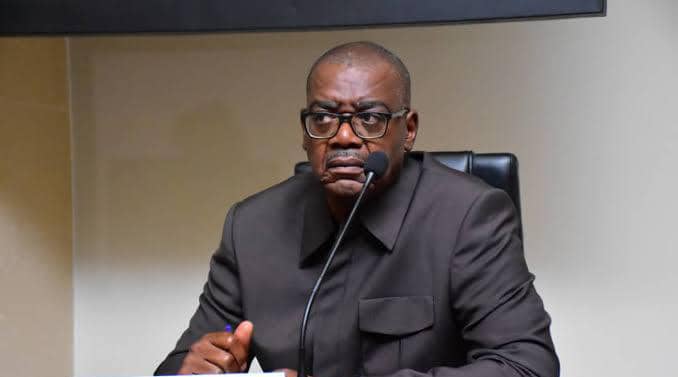
Exclusive interview with Popol Mabolia Yenga, Director General of the Mining Cadastre of the DRC. Mr Yenga is also a member of the advisory board of DRC Mining Week.
Popol Mabolia Yenga, Director General of the Mining Cadastre of the DRC and advisory board member of DRC Mining Week, reflects on his career and current priorities. Appointed by presidential ordinance in 2023 and reconfirmed in 2026, he previously coordinated the CTCPM, led the World Bank‑funded PROMINES project, and oversaw the Kimberley Process Commission. His early career was spent at Gécamines in Kinshasa, London, New York and Brussels.
Today, Mr Yenga’s focus lies on digitising archives and cleaning up the cadastral database to secure reliable mining information and enforce compliance. He stresses that energy is the decisive factor for industrialisation, noting a deficit of more than 1,000 MW that constrains growth. Geological exploration is equally vital, as only 20% of resources are known. Yenga envisions a shift from extraction to processing, diversification of sector players, and energy placed firmly at the heart of Congo’s development strategy.
Could we start with a few words about your background, your career to date, and your current role?
By Presidential Ordinance of 26 June 2023, I was appointed Director General of the Mining Cadastre of the DRC (CAMI) as of 1 August 2023, and my mandate was renewed through the Presidential Ordinance of 20 February 2026.
Before this role, I served as Coordinator of the Technical Cell for Mining Coordination and Planning (CTCPM), an entity within the office of the Minister of Mines, from late 2017 until 2023.
I also had the responsibility of leading the PROMINES Project at the Ministry of Mines as National Coordinator. This nine‑year, $50 million programme, financed by the World Bank, supported good governance in the mining sector to promote economic growth in the DRC. The project concluded in December 2018.
Prior to heading PROMINES in 2009, I was Coordinator of the DRC Kimberley Process Commission within the Ministry of Mines from 2003 to 2009. In this capacity, I oversaw issues related to conflict minerals, precious and semi‑precious stones, gold, and the 3T minerals. I also chaired the steering committee of the ICGLR’s Regional Initiative against the Illegal Exploitation of Natural Resources.
From 1986 to 2003, I worked with Gécamines, the national copper company of the DRC, in Kinshasa, London, New York, and Brussels. During that period, I held various positions in coverage, sales, marketing, and financial analysis.
Which of the Mining Cadastre’s current projects are you particularly excited about right now?
At this stage, our priorities are focused on two main areas: the digitisation of archives and the cleanup of the cadastral database.
Regarding digitisation, it is important to remember that a cadastre is not limited to land management; it also serves as the custodian of the memory of past and ongoing mining activities in the DRC. As such, digitisation is a strategic necessity. It not only secures and preserves the data but also facilitates access to and use of the information. Indeed, simple physical storage exposes documents to risks of deterioration, loss, or alteration, thereby compromising the continuity and reliability of cadastral information.
As for the cleanup of the cadastral registry, this involves freeing up mining areas from non-compliant titles that have been irregularly maintained on national territory. This approach relies on the rigorous enforcement of the obligations to maintain validity set forth in current regulations, particularly the payment of surface rights and compliance with deadlines for commencing work. Through this process, CAMI ensures effective, legal, and economically justified occupation of the mining domain, while preventing the speculative hoarding of granted areas.
Regarding the mining industry, industrialisation is a key issue for stakeholders, particularly in the battery mineral sector. What is needed for the DRC to seize the opportunity to industrialise the mining sector?
The main obstacle to industrialisation remains, unequivocally, the issue of energy. It is unrealistic to envision a genuine industrial boom in the absence of sufficient and stable energy capacity. In this regard, the mining sector faces an energy deficit of over 1,000 MW, which constitutes a major structural constraint on its development.
In this context, ongoing projects aimed at addressing this deficit must be considered strategic priorities and should not be subject to any administrative or operational delays. On the contrary, they should benefit from specific support measures and enhanced facilitation to accelerate their implementation.
Furthermore, although the DRC’s geological potential is considerable, it should be noted that only an estimated 20% of the country’s mineral resources are currently known. This situation highlights a fundamental challenge: the future of the mining industry depends directly on today’s discoveries. Indeed, current operations have a limited lifespan, estimated at around twenty years, which means we must begin planning now for the renewal of resources.
Consequently, the discovery of new deposits—particularly world-class ones—appears to be an essential condition for the sustainability of the mining sector. To this end, geological research is the key driver and must be established as a national strategic priority, on par with the development of energy infrastructure.
In your view, what are the main challenges and opportunities?
Given the above, the main investment opportunities lie in the development of energy infrastructure, which is essential to address the shortfall currently affecting the mining sector. In the context of energy sector liberalisation, investors are encouraged to explore high-potential areas identified in the Renewable Energy Atlas and to engage with the Electricity Sector Regulatory Authority to ensure their projects are properly structured and secured.
Furthermore, regarding geological exploration, investors are advised to contact the Mining Cadastre (CAMI) to obtain exploration permits, or the National Geological Service of the Congo (SGNC) to establish partnerships within the Geological Exploration Zones, thereby enabling them to actively participate in the discovery of tomorrow’s resources.
As a member of the DRC Mining Week advisory committee, what is your vision for the mining sector in the Copperbelt?
My vision is, above all, for our country to cease being solely an extractive economy and to become a processing economy as well, in order to capture a significant share of the value added from our resources. To this end, I reiterate that energy must be placed at the heart of our development strategy.
Furthermore, this vision is accompanied by a process—already underway—of diversifying the players in the mining sector. Historically, the sector has been marked by a strong predominance of Asian players, a situation that has at times led to economic concentration. This situation has, in fact, led us to adopt significant regulatory measures, particularly in the cobalt sector, in order to preserve market balance and national interests.
DRC Mining Week celebrated its 20th edition last year. Over the past two decades, how important has this event been in fostering dialogue, knowledge sharing, and commercial innovation within the mining community?
The importance of this event lies in the fact that it provides a unique setting for informal exchanges among key players in the mining sector, the government, companies, and civil society. It offers a prime opportunity to discuss sector challenges, explore partnership opportunities, and—for the Mining Registry in particular—promote the mining sector’s potential to attract more investment.
How important is the role of a strong sectoral advisory committee for an event such as DRC Mining Week? What are your thoughts on how this gathering might evolve, or on the issues you believe should be addressed?
The sectoral advisory committee is particularly important in that it brings together leading stakeholders from diverse backgrounds: academia, industry, the supply chain, public institutions, and civil society. This diversity is a true asset, as it allows for the exchange of perspectives and the emergence of innovative approaches that are tailored to the needs of businesses, workers, and local communities.
Regarding the topics to be addressed, I believe it is essential to structure our discussions around three priority areas. The first concerns the financing of mining projects, given that a significant number of mining rights are currently held by licensees who face difficulties in mobilising the resources necessary for their development. To this end, we should consider mechanisms to facilitate connections between license holders and investors.
The second priority concerns Geological Research Zones, which, through structured partnerships with the National Geological Service of the Congo (SGNC), serve as an innovative tool to boost exploration, particularly in exchange for preemptive rights.
Finally, the third priority concerns concrete measures to be considered to improve the attractiveness of the energy sector, an essential condition for the sustainable development and transformation of the mining sector.


