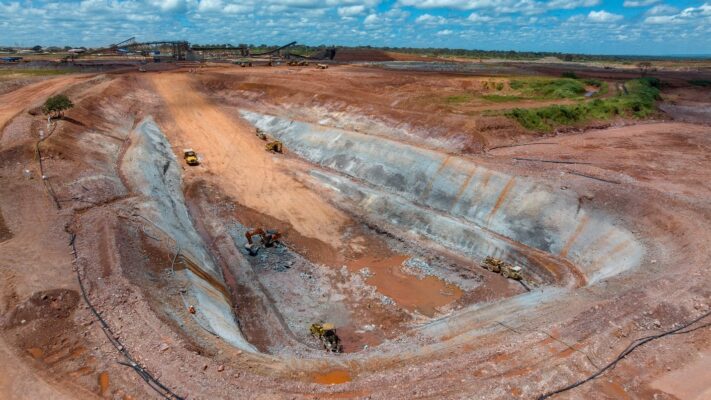
Canadian mining company Ivanhoe Mines has announced its first-quarter 2026 production results, with the Kamoa-Kakula Copper Complex in the Democratic Republic of Congo delivering 71,417 tonnes of copper in blister and anode.
According to the company’s Executive Co-Chair Robert Friedland and President and Chief Executive Officer Marna Cloete, the figure comprises 63,671 tonnes of copper in anode from the company’s on-site direct-to-blister smelter and 7,746 tonnes of copper in blister from the Lualaba Copper Smelter.
The smelter also generated 117,871 tonnes of high-strength sulphuric acid as a by-product. Kipushi mine posted a record 65,044 tonnes of zinc in concentrate, a 6% increase over the fourth quarter of 2025, while Platreef’s Phase 1 concentrator continued ramp-up using development ore ahead of Shaft 3 commissioning.
“We are expecting that the continued closure of the Straits of Hormuz will have a profound effect on global supply chains. Therefore, contingency plans have been drawn up across Ivanhoe’s operating sites to sustain its operations, including advanced diesel purchases. Our mine-site managers are prudent and optimistic that we are well-positioned,” said Friedland.
“If the closure of the Straits of Hormuz continues, we are especially concerned about the availability of precursor materials necessary for the mining industry to continue operating. A second-derivative effect will be on global copper production due to the shortage of the world’s most important industrial chemical, sulphuric acid. Approximately 20% of global copper supply relies on a process that uses sulphuric acid to leach copper from oxide ores. With approximately 50% of the global seaborne sulphur supply cut off, sulphur and sulphuric acid markets are becoming extremely tight.
“Against this backdrop, Kamoa-Kakula is ideally positioned as a producer and seller, and therefore not a consumer, of sulphuric acid … Our on-site copper smelter produces high-strength sulphuric acid as a by-product, which we sell to oxide copper mining operations in the DRC Copperbelt. To be clear, our industrial process does not require sulphuric acid to produce 99.7%-pure copper anodes. In addition, we have refurbished over 250 megawatts of hydroelectric capacity in the Democratic Republic of the Congo that powers our operations … and soon we will have an additional 60 megawatts of power from our new solar field with battery storage. Kamoa-Kakula has a very low rate of diesel consumption per tonne of copper produced, further strengthening the strategic advantage of our integrated operations.
“The Platreef Mine’s Phase 2 expansion is advancing on schedule. The recent completion of Shaft #3 is a major milestone that dramatically accelerates the project.
“At Kipushi, we’ve delivered yet another record-breaking quarter, mining the highest-grade zinc in the world. With further improvements made to the management of grid and back-up power, further throughput gains are to come.”
The Kamoa-Kakula complex milled 3.11 million tonnes of ore through its Phase 1, 2 and 3 concentrators during the quarter, yielding 61,906 tonnes of copper in concentrate. Contained copper inventory stood at approximately 40,000 tonnes at quarter-end, down from 50,000 tonnes at the close of 2025.
An updated mineral reserve estimate released on March 31, 2026, increased the Kamoa-Kakula reserve to 466 million tonnes of ore grading 2.82% copper, containing 13.1 million tonnes of copper. The revised mine plan supports a combined steady-state milling rate of 17 million tonnes per annum across the three concentrators over a 25-year life-of-mine, with revised 2026 copper guidance set at 290,000 to 330,000 tonnes of copper in anode or blister. Production is forecast to climb above 500,000 tonnes annually from 2028 onward.
Kamoa-Kakula’s 500,000-tonne-per-annum smelter operated at 60% of design capacity, targeting 850 tonnes per day of copper in anode. The facility is also producing sulphuric acid at 1,350 tonnes per day, sold to six nearby oxide copper operations at approximately $500 per tonne.
First shipments of 99.7%-pure copper anodes left via the Lobito Railway Corridor, cutting transit time to Europe to seven days versus more than three weeks by road. Dewatering of the Kakula mine is more than 70% complete, and development is shifting toward higher-grade eastern sections to support the ramp-up.
At Kipushi, the concentrator milled a record 196,774 tonnes of ore at an average grade of 36.96%, achieving over 90% recovery for the first time. Recent upgrades to the 120-kV electrical substation and a 20% increase in on-site backup generator capacity to 20 megawatts have improved reliability despite grid instability. Lining of the new tailings storage facility extension is 70% complete, with first tailings deposition scheduled for October 2026.
Platreef’s 0.8-million-tonne-per-annum Phase 1 concentrator was campaigned with lower-grade development ore. Shaft 3, completed on schedule in late March 2026 and licensed for commercial use on April 1, will increase hoisting capacity fivefold once fully ramped up in the coming weeks.
This will enable continuous feeding of higher-grade stoping ore, with commercial production expected by mid-year. Early works on the 3.3-million-tonne-per-annum Phase 2 concentrator began in the first quarter, with groundbreaking occurring ahead of schedule on April 9. Shaft 2 widening using the slipe-and-line method also commenced on April 1, targeting readiness for labour and materials by the end of 2028.
Ivanhoe’s results underscore its operational resilience and low-carbon advantage in a tightening global metals market. With hydroelectric power, on-site acid production, and accelerated development at all three assets, the company is positioned to deliver growing copper and zinc output while mitigating external supply-chain risks.