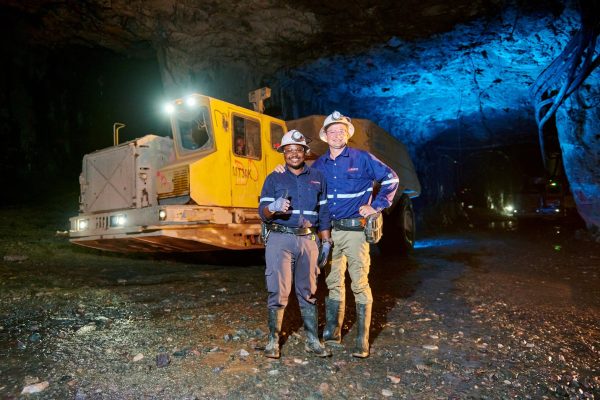
Canadian mining company, Ivanhoe Mines has resumed underground mining operations on the western side of the Kakula Mine at its Kamoa-Kakula Copper Complex in the Democratic Republic of the Congo (DRC), following a temporary halt caused by seismic activity in May 2025. Mining crews and equipment returned underground on June 7 after water levels were stabilized and updated safety protocols were implemented.
According to the company’s Executive Co-Chairman Robert Friedland and President & Chief Executive Officer Marna Cloete, the restart was conducted in a safe and conservative manner, incorporating recommendations from preliminary geotechnical findings. “We are thankful and deeply appreciate our team’s swift response to stabilize underground water levels in the Kakula Mine and resume mining,” Friedland said. Cloete emphasized that “safety has always been, and will always remain, our highest priority.”
The seismic event, first reported on May 18, led to an increase in underground water inflows and a suspension of underground activity. Since then, Ivanhoe Mines and its Kamoa-Kakula technical teams have installed an additional 4,400 litres per second of pumping capacity to stabilize conditions. Mining is resuming gradually, with crews aiming to ramp up extraction on the western side to 300,000 tonnes per month—equivalent to 3.6 million tonnes annually—during the second half of the year.
Meanwhile, development is set to begin imminently on a new mining area located further east of the current Kakula operations. This area is isolated from the dewatering zone and will be accessed through two newly constructed underground drives. Dewatering of the flooded eastern side is scheduled to commence in August and conclude by the fourth quarter of 2025.
The company engaged two independent geotechnical consultants—Beck Engineering of Australia and Open House Management Solutions of South Africa—to investigate the cause of the seismic activity. Preliminary findings suggest the instability stemmed from stress redistribution within a mature extraction zone, where backfill material failed to fully prevent overloading of regional support pillars. Updated short-term mine plans now include increased pillar widths and improved mining sequences, while long-term plans are under review.
Operations at the Phase 1 and 2 concentrators, which have been running at about 50% capacity using surface stockpiles, are expected to ramp up as underground mining resumes. The Phase 3 concentrator near the Kamoa area continues to outperform, processing ore at 30% above its design capacity.
As a result of the disruption, Ivanhoe has revised its 2025 copper production guidance from the original 520,000 tonnes to between 370,000 and 420,000 tonnes. The company also withdrew its 2026 guidance of 600,000 tonnes pending further assessment.
Despite the recent challenges, Ivanhoe remains optimistic about the future. The on-site smelter is expected to begin operations in September, producing its first copper anode in October. Additionally, the commissioning of the 178-megawatt Turbine #5 at the Inga II hydroelectric dam is anticipated to further enhance power reliability for the complex later this year.
Ivanhoe Mines will host an investor call on June 12 to provide more details on the operational update.