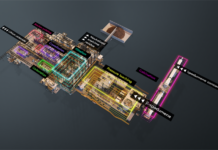
Ivanhoe Mines chairs’ Robert Friedland and Yufeng Sun announced underground development at the Kamoa-Kakula Copper Project in the Democratic Republic of Congo (DRC) totalled 2,172 metres in October. This marks another new monthly record and brings total underground development to more than 24.7 kilometres – approximately 7.9 kilometres ahead of schedule. Mr. Friedland and Mr. Sun also noted that mining crews produced a combined 194,000 tonnes of ore in October from the Kakula and Kansoko mines, which was 48% higher than achieved in September. The project’s pre-production surface stockpiles now contain approximately one million tonnes of high-grade and medium-grade ore at an estimated grade of 3.47% copper.
The enormous amount of pre-production development completed to date at both the Kakula and Kansoko mines has positioned the project for a significant acceleration in the tonnage, as well as a marked increase in the grade, of ore added to the project’s surface stockpiles beginning this month.
The monthly total of 2,172 metres of underground development in October was comprised of 1,809 metres at the Kakula Mine and 363 metres at the Kansoko Mine, which is located at the Kamoa Deposit – approximately 10 kilometres north of the Kakula Mine.
At Kakula, both main access tunnels (drives) being advanced from the southern decline, and the spiral access drive being advanced from the northern decline, have recently accessed the high-grade zone near the centre of the deposit grading approximately +8% copper Kakula’s main access drives between the northern and southern declines have less than 100 metres remaining before they are connected (holed) in the high-grade centre of the deposit. The holing will significantly increase ventilation to the centre of the orebody, allowing for additional mining crews to begin highly-productive mining operations in Kakula’s high-grade ore zones.
Accordong to Mark Farren, the imminent joining of Kakula’s northern and southern main access drives will be a major milestone in the mine’s development. Once this is achieved, the opening up and ledging of the drift-and-fill blocks can commence in the high-grade core of the deposit, where the average grade is projected to exceed 8% copper.
Kakula’s second underground ore bin (the west tip bin) is undergoing commissioning. Installation of Kakula’s ventilation shaft #2 also is progressing well, with the first of three high-capacity surface fans installed by the contractor.
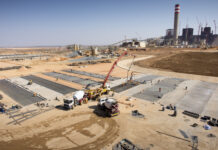
The gabion wall for the surface bulk reclaim tip system that is located near Kakula’s main northern decline has been constructed and preparation has started for the civil works required at the top of the wall. The bulk reclaim tip system will be used to feed ore from Kakula’s surface stockpiles (and ore from the Kansoko Mine when second-phase operations begin) to the processing circuit.
Underground development at the Kansoko Mine currently is in low-to-medium-grade ore zones, grading approximately 3% copper. In October, mine development work intersected the first exposure of siltstone, marking the transition to higher copper grades at Kansoko. Siltstone is a rock type with a strong influence on copper mineralization at Kamoa-Kakula.
Phase 1 copper production from the Kakula Mine is scheduled to begin in July 2021. Kakula is projected to be the world’s highest-grade major copper mine, with an initial mining rate of 3.8 Mtpa at an estimated average feed grade of more than 6.0% copper over the first five years of operation. Phases 1 and 2 combined are forecast to produce approximately 400,000 tonnes of copper per year. Based on independent benchmarking, the project’s phased expansion scenario to 19 Mtpa would position Kamoa-Kakula as the world’s second largest copper mining complex, with peak annual copper production of more than 800,000 tonnes.
In accordance with health guidelines from the DRC government, and in line with the country’s lifting of restrictions, Kamoa-Kakula’s Congolese workforce has gone back to normal work rotations. Rigorous testing, physical distancing, wearing face masks, frequent hand washing and contact-tracing measures are still in place to protect the safety and health of the workforce and community members. All expatriate employees are still required to quarantine for two weeks upon arrival at Kamoa-Kakula.
The project has established a COVID-19 isolation facility at the Kamoa camp. Potential symptomatic patients are moved to this facility, where they will be isolated, tested and treated. Once patients have recovered and are deemed no longer infectious, they can return to work only after an additional quarantine period determined by the project’s medical staff.
As the pandemic evolves, the medical team at Kamoa-Kakula continues to review and update its risk mitigation protocols. The project’s preventative measures are at the highest international standards and, if there was a case internally, the risk of spreading or cross-contamination is considered to be very low.