Corrosion is a persistent threat to mining infrastructure, where metals are exposed to harsh environments—moist soils, saline water, and chemical-laden solutions. Among the most effective solutions to combat this challenge is impressed current cathodic protection (ICCP), a method that leverages electrical current to shield metal structures from degradation. This article explores the principles, benefits, applications, and recent advancements of ICCP systems in the mining sector.
Understanding Impressed Current Cathodic Protection
Impressed current cathodic protection is a corrosion control technique that uses an external power source to supply direct current (DC) to a metal structure, making it the cathode in an electrochemical cell. By doing so, the natural electrochemical reactions that cause corrosion are reversed or halted, significantly extending the lifespan of the protected metal.
Key Components and Operation
- External Power Source: Typically, a rectifier converts alternating current (AC) to DC, supplying the necessary protective current to the system.
- Anode System: ICCP employs inert anodes—often made from mixed metal oxides (MMO), graphite, or titanium—that are installed in the surrounding environment (such as soil or water) near the structure to be protected
- Protective Current Flow: The DC current drives electrons from the anode to the metal structure, forcing the structure to become cathodic (negatively charged), thereby preventing the oxidation that leads to corrosion
- Adjustability: The current and voltage can be finely tuned to match the specific requirements of the structure and its environment, ensuring uniform protection across large or complex installations
- Monitoring and Maintenance: ICCP systems often include reference electrodes and monitoring devices to ensure the structure remains within the desired protection range. Regular inspections and adjustments are critical for maintaining system effectiveness.
Applications in Mining
The mining industry relies on a wide array of metal and concrete structures—such as pipelines, processing tanks, storage vessels, and support beams—that are highly susceptible to corrosion due to constant exposure to moisture, chemicals, and fluctuating temperatures. ICCP is particularly suited for these applications due to its scalability, durability, and adaptability.
Buried pipelines and above-ground storage tanks are critical for transporting and storing ores, process water, and chemicals. These structures are often in continuous contact with corrosive soils or solutions. ICCP systems provide continuous, adjustable protection, ensuring the integrity of these assets over long periods.
Processing Equipment
Metal components in mineral processing plants—such as crushers, mills, and agitators—are exposed to abrasive and corrosive materials. ICCP can be integrated into these environments to extend equipment life and reduce downtime.
Advantages of ICCP in Mining
- Long-Term Protection: ICCP systems use inert anodes that do not degrade rapidly, providing continuous protection for decades with minimal replacement needs.
- Scalability: The external power source allows ICCP to be scaled up for large or complex structures, making it more cost-effective than sacrificial anode systems for extensive mining operations.
- Adjustability: The protective current can be precisely controlled to adapt to changing environmental conditions or structural requirements.
- Reduced Maintenance: With fewer anode replacements and less frequent maintenance, ICCP systems lower operational costs and improve safety by reducing the need for access to hazardous areas.
ICCP is particularly advantageous for large-scale mining operations, where sacrificial anode systems would require frequent replacements and incur higher fuel and maintenance costs.
Key Monitoring Methods and Technologies
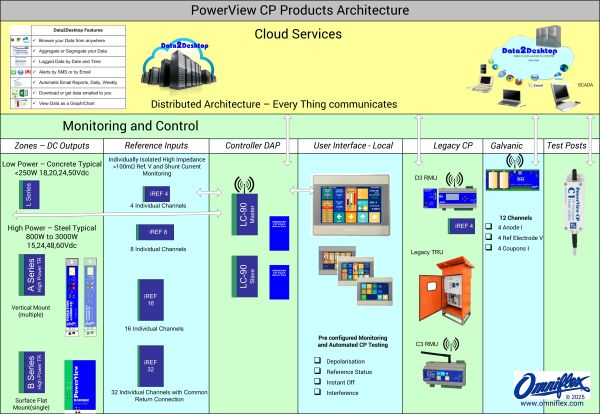
- Automated Monitoring Systems: Modern ICCP systems employ sophisticated monitoring equipment that continuously measures critical parameters such as structure potential, current density, and anode potential. These real-time measurements allow operators to ensure that the system is operating within specified protective parameters, enabling prompt adjustments if deviations occur.
- Remote Monitoring: Remote monitoring technology has become increasingly important in mining environments. By utilizing wireless sensors and data transmission, operators can access performance data from ICCP systems without physically visiting hazardous or hard-to-reach underground areas. This not only reduces personnel exposure to risk but also provides continuous, 24/7 insight into system status, allowing for quicker identification and resolution of faults.
- Data Integration and Analysis: Centralized platforms, such as IOT Cloud based Data Servers allow for historical trend analysis, scheduling of inspections, and triggering of maintenance or repairs based on monitoring results. Data from ICCP systems can be integrated with other mine monitoring data for comprehensive asset management.
- Reference Electrodes and Sensors: Reference electrodes are strategically placed near protected structures to measure the electrical potential, which indicates the level of protection provided by the ICCP system. Other sensors may monitor environmental conditions (such as temperature, humidity, and soil resistivity) that can affect ICCP performance.
- Alarm and Notification Systems: Automated monitoring systems can be configured to send alerts or notifications when parameters fall outside safe ranges, ensuring rapid response to potential issues. This is particularly valuable in underground mines, where manual inspections are less frequent and more hazardous.
Operational Considerations
- Regular Surveys and Inspections: Despite advances in automation, periodic in-person surveys remain important for verifying system integrity and calibrating equipment. However, remote monitoring reduces the frequency, risk and expense associated with these inspections.
- Integration with Mine Monitoring Infrastructure: ICCP monitoring can be integrated with broader mine monitoring and control systems. These systems may also track environmental parameters, equipment status, and safety conditions, creating a holistic approach to mine management and safety.
- Adaptation to Environmental Changes: mine environments can be dynamic, with changes in moisture, temperature, and chemical exposure. Continuous monitoring allows ICCP systems to adapt to these changes, ensuring consistent protection.
Impressed current cathodic protection is a proven, efficient, and adaptable solution for corrosion control in the mining industry. Its ability to provide continuous, adjustable protection for large and complex metal structures makes it indispensable for safeguarding critical infrastructure. With ongoing innovations ICCP systems are becoming even more reliable and cost-effective, ensuring the longevity and safety of mining operations worldwide. As mining environments continue to present new challenges, the evolution of ICCP technology will remain essential for protecting the industry’s vital assets.
In South Africa, for further information contact: Ian Loudon, Omniflex (Pty) Ltd, Unit 4/147 Julia Road, Overport 4001, South Africa
Telephone: +27 (31) 207 7466
www: www.omniflex.com
e-mail: sales@omniflex.com
Twitter: https://twitter.com/omniflex
LinkedIn: https://www.linkedin.com/company/omniflex/
Press enquiries: Patrick Ball or Ian Bolland – Stone Junction Ltd
Suites 1&2 The Malthouse, Water Street, Stafford, Staffordshire, ST16 2AG
Telephone: +44 (0) 1785 225416
e-mail: patrick@stonejunction.co.uk or ian@stonejunction.co.uk
Blog: www.stone-junction.blogspot.com
Twitter: www.twitter.com/StoneJunctionPR
Facebook: http://www.facebook.com/technicalPR
LinkedIn: https://www.linkedin.com/company/stone-junction-ltd