There are many ways to convey bulk materials, and no one knows that better than Dos Santos International. Dos Santos International is the foremost authority on high angle conveyor applications and design of sandwich belt type high angle conveyors. The flagship system is the DSI Sandwich Belt high angle conveyor. This system sandwiches materials between two belts with a gentle, yet firm, hugging pressure. Materials can be elevated to the highest of angles (to 90⁰ vertical), through “C” and “S” shapes, and other unique profiles. Not only is the system versatile, it has proven to be economical, mobile and “green.” Join us in counting the ways.
DSI Sandwich Belt high angle conveyors
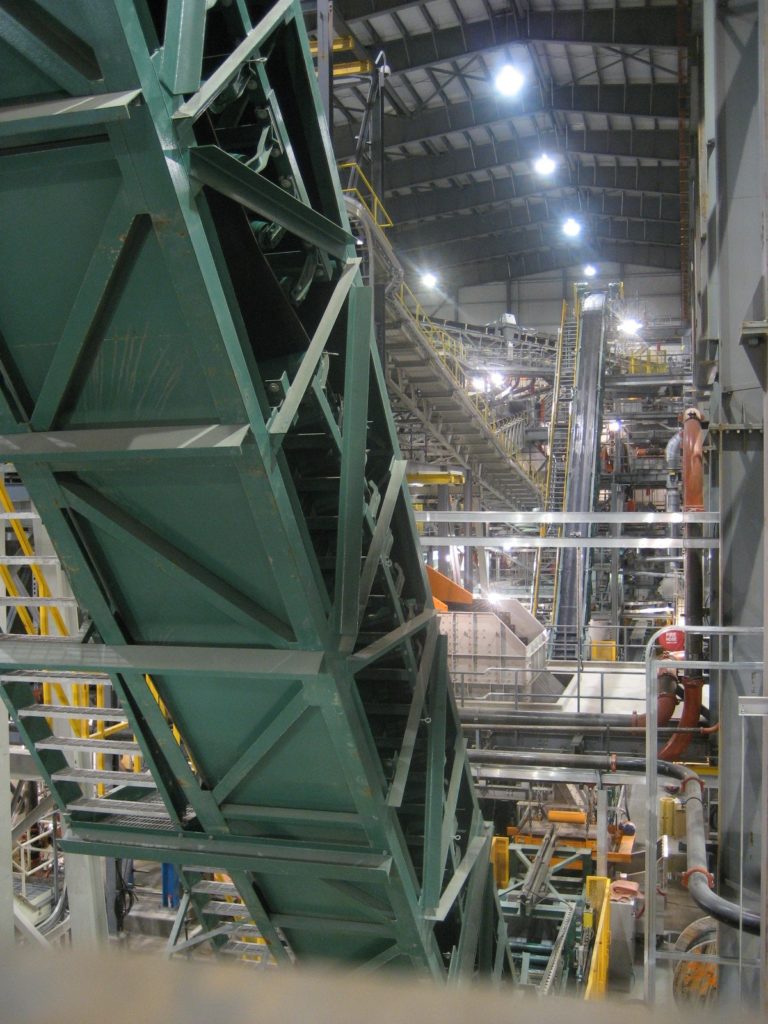
Twenty years ago, “going green” wasn’t quite the popular phrase that it is today. However, that is when Joseph Dos Santos, President of Dos Santos International was presented with a challenge to go green like no other. The challenge was to use the least amount of space possible to process and separate one of Earth’s greatest treasures…diamonds. The picture to the left shows the surface facilities of Canada’s first completely underground diamond mine, Snap Lake. Snap Lake was the motivation for the DSI Sandwich Belt Conveyors in the Northwest Territories.
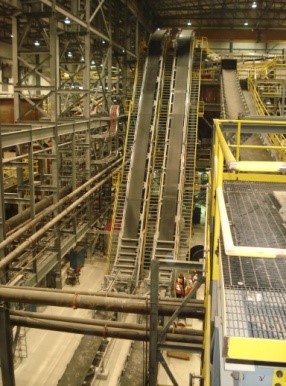
The Snap Lake ore body is a dyke that dips an average of 12-15° from the northwest shore down under the lake. Kimberlite, the diamond bearing ore, is brought to the surface to a processing facility where the diamonds are extracted. Due to the hostile environment, the facilities must be enclosed and heated. A smaller footprint for the plant was determined to be the optimal way to minimize environmental impact and cost. This led to pursuit of the DSI Sandwich High Angle Conveyor because of its designed space saving features. In the process building, the kimberlite must be elevated then discharged into the various crushing, screening and sorting functions. The original concept was to use a multitude of DSI Sandwich conveyors to minimize the facilities. This was ultimately rationalized to require only two sandwich conveyors, which now define the facility’s minimal footprint. The DSI Sandwich Belt Conveyor’s ability to convey at any high angle made it ideal. The sandwich belt technology imparts a gentle yet firm hugging pressure on the material in the belt sandwich.
This allows the precious gems within the kimberlite to be elevated at high angles without damage or spillage. The Snap Lake project incorporates two sandwich conveyors, each traveling to opposite ends of the building. The units were standardized at 36” belt width to simplify spare parts inventory. Design of the units included provision for future upgrade, from 275 t/h to 524 t/h, merely by increasing the belt speed. By operating at the lower speed until the upgrade is required the conveyors optimal energy efficiency is preserved. The success of the Snap Lake system then led to the incorporation of DSI Sandwich conveyors with confidence into the Victor Project in Northeastern Ontario. Ontario’s first diamond mine incorporated three DSI Sandwich belt units.
DSI Fully Mobile high angle conveyor shiploader
Moving on to expanded mobility, there is no better example of the versatility of a DSI Snake than Australia’s first DSI Snake Sandwich High-Angle shiploader at the Port of Adelaide on Australia’s southern coast. Australia’s first Snake shiploader elevates a variety of high value ores from trucks to ship. Conventional conveyors would not have fit the limited dock space which required a smaller footprint. Dos Santos International, being the world’s foremost authority on high angle conveying was able to fit the space easily by being able to elevate at a 50 degree angle. If fitting the space wasn’t enough, DSI went a step above and created a mobile shiploader to elevate the materials with ease.
Materials for export are trucked to the dock and dumped onto a special trap loader type feeder. The ore is fed continuously and uniformly onto the mobile snake’s receiving chute. The Snake Ship Loader elevates the bulk over the ship’s deck to the hatch where it is discharged into the ship’s hold. At the Snake’s discharge, a special telescoping chute, with rotating, pivoting spoon, facilitates even and complete filling of the holds. The mobile Snake is carried on a tripod of twin rubber tires. Each set of twin tires is mounted at a vertical kingpin and can rotate 360 degrees about the vertical axis. Thus, without repositioning, the Snake can set up to travel in any direction. With the tail tires fixed, the front tires can be oriented and traveled for a slewing motion.
The unit was complete in November 2006. This first DSI Snake Ship Loader for Australia has set the pace for many more high volume high-angle installations at materials handling docks and yards throughout the world.
DSI Overland conveyors
There can be no finer example of DSI’s ability to exceed all customer requirements than the system at Goldcorp’s Los Filos gold mining site. This gold mining project, located in the Nukay mining district of central Guerrero State in southern Mexico is one the largest gold mines in the world.
Los Filos is a heap leach operation. The ore size is reduced at the crushing plant and then it is hauled to the valley where it is stacked on engineered pads. A chemical solution is sprayed onto the ore, which extracts and absorbs the gold as it trickles through the ore. To regulate seepage rate, agglomerate (cement) is mixed into the ore for optimal ore exposure to the solution. Ultimately, the solution is directed to the plant where the gold is precipitated out.
A previous short-lived system conveyed the ore from the crushing plant to the leach pads via a glory hole ore pass and an underground conveyor, through the hill. An agglomeration drum mixed in the agglomerate before final delivery to the leach pads. This conveying system experienced material flow problems right from the start, especially during heavy rains. The sticky ore tended to plug up the ore pass. Geological instability ultimately collapsed the ore pass, putting the transport system out of service only four months into its operation.
Against this background, M3 Engineering was tasked with developing an alternate conveying route quickly since all haulage was now by truck and very expensive. The logical, most direct and economical path was over the same hill (rather than under). The path required a down-hill high angle conveyor; thus, Dos Santos International was approached about their DSI Sandwich Belt High Angle Conveyor. Being the best solution, DSI was awarded the contract in March 2009 for a downhill high-angle conveying system which they dubbed the DSI G.P.S. (Gently Pressed Sandwich) High Angle Conveyor.
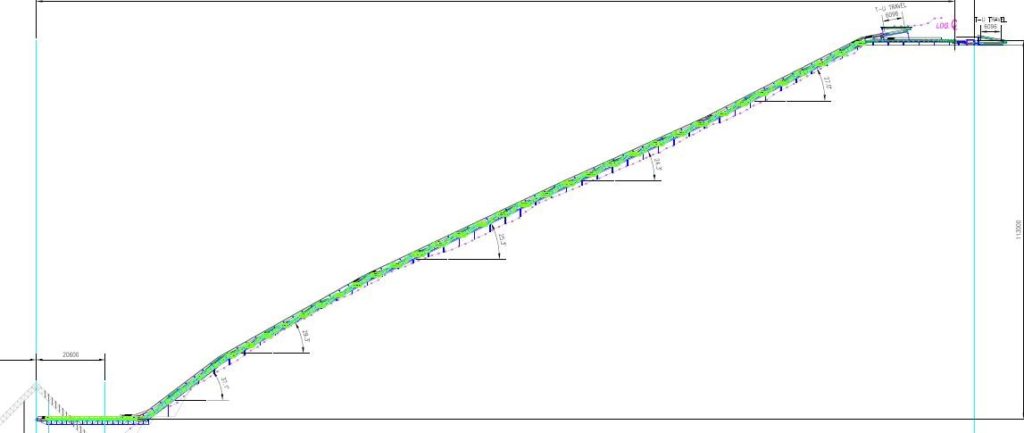
Concerns with geological instability remained, especially along the path of the DSI GPS. Further geological scrutiny led to abandoning this path altogether, thus abandoning the DSI GPS as well. M3 was again tasked with developing an alternate conveying path. This time a conventional conveyor system was developed, following the already developed truck ramps. Dos Santos International again submitted their proposal for the project, now an overland conveyor system. The project was awarded to DSI May 19, 2009.
The Dos Santos International proposal included two important commitments solely for the customer’s benefit:
- DSI would maximize use of the conveying equipment and structure, already at the mine, from the collapsed and abandoned through-the-hill conveying system.
- The awarded ten-flight system appeared to be a candidate for further rationalization and cost reduction, using horizontal curves to amalgamate successive conveyor flights. The DSI proposal included an amalgamation study as the first order of business.
Both commitments were fulfilled reaping substantial cost savings to the customer.
In the former case, the conveyor dubbed, “TB25,” was engineered to use all existing conveyor equipment and structure. Though the arrangement is entirely new, the equipment and support steel are reused from the previous system. The head drive terminal is the only component of TB25 that has new equipment. New steel at the support bents, minor framing, and a new discharge chute make up only a small portion of the total structure.
In the latter case, the amalgamation study revealed that six conveyor flights could be reduced to three when joined with horizontal curves. The ten flight system was reduced to seven flights. TB26, TB28 and TB29, each with a horizontal curve, are products of the study.
The DSI expertise thus proved particularly advantageous using the horizontal curves to simplify the system and to reduce both capital and operating and maintenance costs. Additionally, the third conveyor flight, TB27 is especially engineered to accomplish the agglomeration by mixing through five intermediate tripped transfers. The enroute agglomeration, conceived by Goldcorp, results in substantial savings by eliminating the need for the additional agglomerating drum.