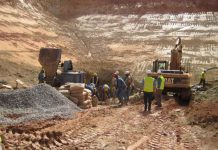
GoviEx Uranium Inc., a company focused on exploring and developing uranium assets in Africa, has announced the start of its 2025 field season at the Muntanga uranium project in Zambia.
The campaign follows four years of intensive work, including a positive feasibility study that returned a post-tax NPV8% of USD243 million. Building on these results, GoviEx is expanding its exploration programme to grow the project’s resource base, extend mine life, and uncover new deposits that could significantly boost its scale and long-term value.
“After years of feasibility and engineering work, we’re excited to refocus on exploration. Muntanga has a solid resource base, but the real opportunity lies in expanding it—especially in the underexplored Kariba Valley, which could be a game-changer,” said Govind Friedland, Executive Chairman.
The 2025 campaign will consist of 35 drill holes for approximately 3500 metres and will test four high priority areas, ranging from near-mine targets that could extend Muntanga itself to a potential larger-scale opportunity at Kariba Valley, situated on strike and on trend 70 kilometres to the south-east of Muntanga.
GoviEx’s geological team has reassessed three priority areas, identifying promising potential based on historical drilling and an updated geological model presented during a recent site visit.
Priority drilling will begin at Muntanga East, where ten shallow holes (up to 60 metres) will follow up on past intercepts over a radiometric anomaly located 5 km from the planned open pit. The target lies within the same Escarpment Grit Formation that hosts the current resource. Geological interpretation suggests a shallow exploration target of 2–4 million pounds of U₃O₈, with grades between 150 and 350 ppm.
The programme also targets areas around the Dibbwi deposit, where new modelling indicates strong potential to extend mineralisation. Five drill holes are planned east of the current Dibbwi pit, focused on a well-defined radon anomaly that aligns with the mineralised trend but has never been tested. This anomaly was identified in a radiometric survey conducted after earlier drilling, making it a compelling case for resource expansion.
Further south at Dibbwi South, GoviEx will carry out trenching over radon anomalies similar to those at its existing Dibbwi deposit. The goal is to expose the underlying geology for mapping and sampling, aiming to identify near-surface mineralisation for follow-up drilling later in the season.
In the Kariba Valley Mining License (38555-HQ-LML), the Chisebuka prospect is a major exploration focus. Acquired from African Energy Resources in 2017, this area shares the same Karoo sedimentary package as the Muntanga-Dibbwi deposits but has not been drill-tested since initial reconnaissance.
Analysis of historical drilling, radiometric surveys, and mapping confirms the Chisebuka mineralisation remains open in multiple directions. Geological modelling suggests a shallow, gently dipping body traceable along 4 km of strike and up to 1 km across, with mineralised horizons from surface to 110 m depth. GoviEx has outlined a conceptual target of 20–30 million pounds U₃O₈, with grades of 150–300 ppm—consistent with known resources at Muntanga-Dibbwi.
Despite strong geological potential, Chisebuka remains underexplored, as earlier drilling focused only on easily accessible zones. This season’s planned drilling will cover just 3% of the license area, which is considered largely prospective.
GoviEx will drill 20 proof-of-concept holes totaling about 2,000 metres (depths of 50–150 m) to test mineralisation extensions. If confirmed, Chisebuka could move rapidly into resource definition drilling.
Drilling and trenching at all four targets begin next week, with early results guiding follow-up work. The company’s goal remains to expand the Muntanga resource, improve project economics, and enhance long-term stakeholder value.