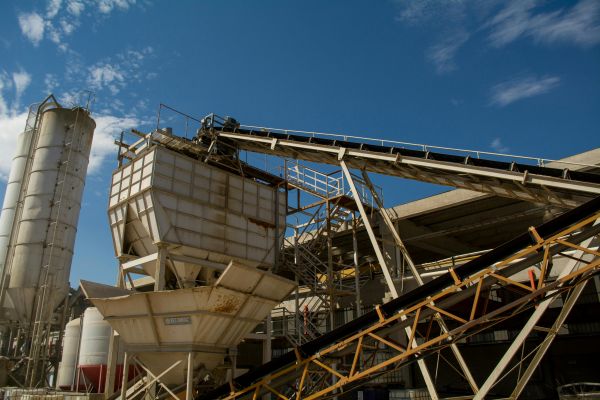
The movement of bulk solids is constant, high volume, and tightly linked to production efficiency. From crushed ore to processed aggregates, materials are typically transported via conveyor belts or screw conveyors, forming the backbone of continuous production. While this seems pretty straightforward, the real challenge lies in knowing exactly how much material is moving at any given moment. This is where mass flow measurement becomes essential. Without accurate throughput data, process control becomes guesswork, and even small deviations can lead to costly inefficiencies, inaccurate billing between production units, or downstream process instability.
In conveyor-based handling systems, the primary measurement task is throughput monitoring. Operators need a continuous, real-time understanding of how many tonnes per hour are being transported, often at rates reaching up to 10 000 t/h. The measuring point is typically the conveyor belt itself, where bulk solids are in motion and constantly changing in load profile. The materials involved can vary widely in particle size, density, and moisture content, and the system must remain reliable across a wide process temperature range, typically from -40 to +60 °C. This variability places high demands on measurement technology, which must remain stable and accurate regardless of environmental and material fluctuations.
Mining environments add another layer of complexity. Conveyor belts are exposed to heavy dust loads, mechanical vibration, uneven belt tension, and constantly changing material characteristics. Larger and smaller particles may mix unpredictably, and flow patterns are rarely uniform. Traditional mechanical weighing systems can struggle under these conditions due to wear, drift, or sensitivity to vibration. As a result, non-contact and robust measurement technologies are increasingly preferred for long-term stability and reduced maintenance requirements.
Why Mass Flow Matters:
Accurate throughput measurement on conveyor belts ensures reliable production control, prevents material losses, and enables precise inter-unit billing across mining operations handling up to 10,000 t/h of bulk solids.
A proven solution for these demanding applications is the use of radiometric mass flow measurement systems such as the WEIGHTRAC 31. This instrument is designed specifically for the continuous measurement of bulk solids on conveyor belts. Its frame-based construction allows for straightforward retrofit installation onto existing conveyor systems, making it particularly attractive for upgrades or plant optimisation projects without major mechanical modification. The WEIGHTRAC 31 operates using a radiation-based principle, enabling it to measure mass flow without physical contact with the material or conveyor.
Because the measurement is non-contact, the system is largely unaffected by dust, dirt build-up, or material abrasion. This is a significant advantage in mining environments, where conventional systems can degrade quickly under harsh conditions. The WEIGHTRAC 31 provides accurate, repeatable throughput measurement even when belt loading is uneven or when vibration levels are high. Its wear-free operation also reduces the need for regular maintenance interventions, which in turn improves overall plant availability and reduces operational downtime.
A key component of any radiometric measurement system is the radiation source holder, such as the VEGASOURCE 81. This unit is responsible for safely housing and directing the gamma emitter used in the measurement process. It ensures that radiation is emitted in a controlled and defined direction towards the measurement path, while effectively shielding the surrounding environment in all other directions. This design is critical for operational safety and regulatory compliance in industrial settings.
The VEGASOURCE 81 is engineered for high operational reliability, featuring pneumatic actuation of the source holder for safe handling and control. Its compact design allows for simple installation even in constrained spaces, while its shielding efficiency helps minimise the need for extensive controlled areas around the installation. This makes it well suited for integration into existing conveyor systems where space and access may be limited.
Employed together, WEIGHTRAC 31 and VEGASOURCE 81 provide a robust solution for continuous mass flow measurement in mining applications. The benefits to operators are significant. Reliable measurement is maintained despite vibration, belt tension changes, and harsh environmental conditions. Accurate throughput data enables precise accounting of bulk material flows between production units, supporting both operational transparency and financial control. At the same time, the system’s low-maintenance, wear-free design reduces lifecycle costs and simplifies long-term operation.
In a sector where every tonne counts, dependable mass flow measurement is not just a technical advantage, it is a fundamental part of efficient, profitable and controlled mining operations.
VEGA will be exhibiting at Electra Mining Africa 2026 at the Johannesburg Expo Centre, Nasrec, from Monday, 7 September to Friday, 11 September 2026. Visit us at Stand B15, Hall 4.