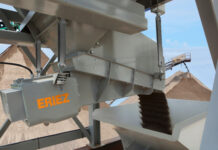
According to a new Eriez® technical paper, badly designed hopper transitions are a common and often underestimated reason vibratory feeding systems underperform
Titled “Optimising Hopper Transitions: Design Guidelines for Maximum Hopper-to-Feeder Performance,” the paper presents practical engineering parameters to help processors achieve consistent material flow, protect equipment, and realise the full rated capacity of vibratory feeders across a wide range of bulk handling applications.
According to the paper’s author, Clay O’Dana, Eriez Global Product Manager-Vibratory, feeder performance issues are often attributed to the feeder itself when the root cause lies upstream, where material exits the bulk hopper and enters the feeder tray.
“Even the most advanced vibratory feeder cannot perform to specification if material is not presented correctly,” O’Dana said. “Transition geometry, throat sizing, and clearances all have a direct impact on capacity, wear, and long-term reliability.”
The paper details several critical design variables that must be aligned with the material’s physical characteristics, including throat opening dimensions, gate height relationships, hopper wall angles, and structural clearances. It explains how improper throat sizing can create excessive headload, reducing feeder amplitude and capacity, while insufficient clearance can dampen vibration and contribute to premature equipment damage.
To support engineers working across diverse applications, the paper also examines common hopper transition configurations, including flat-tray, tubular, and covered tray designs. Illustrated examples show how correctly engineered transitions allow electromagnetic and mechanical vibratory feeders to operate at full stroke and amplitude while maintaining controlled, uniform material flow in demanding environments such as mining, aggregates, recycling, and food processing.
By documenting proven design ratios and installation practices, the paper is intended to help plant engineers, OEMs, and operators identify and resolve feeding issues before they lead to lost throughput or unplanned maintenance.
“Optimising the hopper-to-feeder interface is often the simplest way to unlock better performance from an existing system,” O’Dana said. “These guidelines are based on decades of application experience and are designed to be applied directly in the field.”
The full technical paper is available for download at eriez.com/hoppertransitionstechpaper.