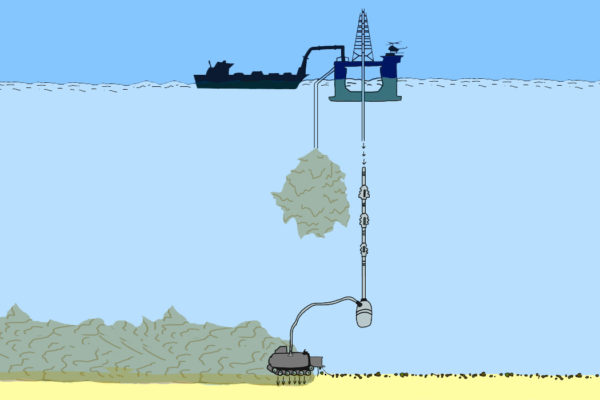
Deep-sea mining has been given the go-ahead to commence in two years, after the tiny Pacific island nation of Nauru notified the UN body governing the nascent industry of plans to start mining.
Nauru’s president, Lionel Aingimea made the announcement and said the intention of Nauru Ocean Resources Inc (NORI), a subsidiary of a Canadian company called DeepGreen, to apply for approval to begin mining in two years in the Clarion-Clipperton Zone (CCZ) in the North Pacific Ocean between Hawaii and Mexico.
DeepGreen is looking to extract polymetallic nodules from the seabed. The nodules, which resemble potatoes and are thought to take millions of years to form, are rich in manganese, nickel, cobalt and rare earth metals, key components of batteries for electric vehicles. DeepGreen argues deep-sea mining is a less environmentally and socially damaging alternative to terrestrial mining, and is crucial for transitioning to a greener economy.
Two-year rule
Triggering the so-called “two-year rule”, which some have called the nuclear option, the International Seabed Authority (ISA) now has two years to finalise regulations governing the controversial industry. In a letter Lionel Aingimea asked the ISA “to complete the adoption of rules, regulations, and procedures required to facilitate the approval of plans of work for exploitation in the area within two years” from 30 June. If it is unable to do so, the ISA is required to allow mining contractors to begin work under whatever regulations are in place at the time.
However, Environmental groups, the EU Parliament, several Pacific nations including Fiji and Papua New Guinea, and Sir David Attenborough, have called for a moratorium on deep-sea mining, arguing that too little is known about its impact. More than 350 scientists from 44 countries signed a petition calling for a moratorium on deep-sea mining “until sufficient and robust scientific information has been obtained”.
“We are currently in the middle of a climate and biodiversity crisis, we know that deep sea ecosystems are some of the most important ecosystems on the planet and we are seeing this relentless and reckless push to mine these areas, despite the fact that scientists are very clearly warning us that the outcomes could be disastrous,” said Jessica Desmond, Oceans campaigner for Greenpeace Aotearoa.