


When Flexibility Matters More Than Ownership
For decades, owning equipment was seen as a badge of operational strength in mining, construction and industrial sectors. A company that owned its access platforms, forklifts, and material-handling fleet had full control and could deploy assets at will.
But that logic is changing.
Project requirements are now harder to predict. A mine may need one type of machine for one phase, and a completely different capability when conditions shift. In this environment, the question is no longer whether a business can afford to own equipment, but whether ownership actually gives it the flexibility it needs.
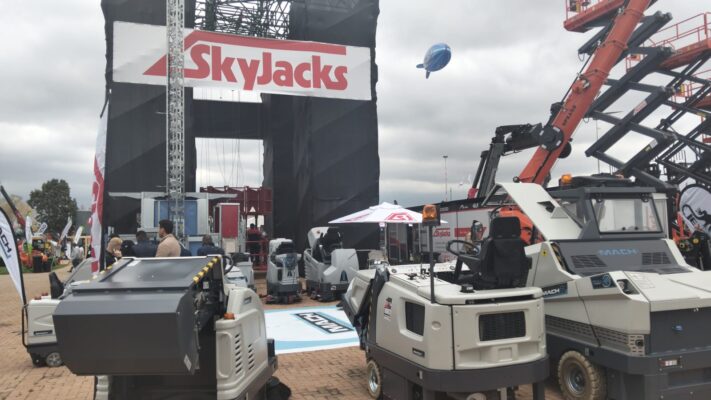
That was the central message from Darryn Jacobs, Managing Director at SkyJacks, at Electra Mining Africa 2026.
“For instance, a project may begin with a requirement for a 20-metre access machine but later require a machine capable of reaching 40 metres,” says Jacobs.
Under a rental model, the first machine can be returned and replaced with one suited to the new requirement — rather than leaving the customer with an asset that no longer matches the job.
This agility is particularly valuable in mining, where specialised equipment is often needed for specific construction, maintenance, rehabilitation or underground activities, rather than on a continuous basis.
The True Cost of Ownership
The financial case for rental extends well beyond the purchase price. Ownership brings ongoing responsibilities for servicing, maintenance, repairs, certification and eventual replacement.
“Another reason rental is becoming attractive is because customers are looking for predictable costs and reliable uptime,” Jacobs adds. “Rental provides professionally maintained equipment without the additional burden of maintenance, repairs and replacement costs.”
For businesses managing multiple projects across sites, this makes budgeting more predictable while reducing the risk of carrying underutilised assets between contracts.
It also provides access to a much broader fleet. SkyJacks’ offering spans powered access, lifting, material handling and industrial cleaning equipment, including its established brands — Dingli, Faresin, Jekko, GEDA and ALR — plus new additions like Hyundai Forklifts and MACH cleaning solutions.
Specialist Equipment Without Permanent Commitment
Rental does not mean generic equipment. The Kamoa Copper Mine project in the DRC is a prime example.
For the DRA project at Kamoa, SkyJacks engineered a custom 4.9-metre circular suspended platform with a gantry specifically for underground truck-silo repairs.The solution incorporated ten 1,000 kg hoists, a 4,000 kg safe working load, and achieved a vertical run exceeding 30 metres.
It demonstrates that the value of an equipment partner lies not just in supplying off-the-shelf machines, but in conducting site inspections and engineering assessments to develop application-specific solutions.
Is Ownership Finished?
Not at all. Ownership remains the right choice where utilisation is high, workloads are predictable, and a business needs permanent access to a specific machine.
But for companies operating in an environment of changing scopes, fluctuating workloads and pressure to control capital expenditure, rental deserves to be considered alongside — and sometimes ahead of — ownership.
As Jacobs puts it, the goal is not to dictate whether customers purchase, finance or rent, but to ensure they can access the right equipment, when and where they need it.
The shift, therefore, is not simply from buying machines to hiring them. It is from thinking about equipment as an asset that must be owned to thinking about it as a capability that must be available.
For mining and industrial businesses facing faster-changing requirements, that distinction is making rental the smarter model.


