


Nitration: The Acid You Didn’t See Coming
By Steven Lumley, technical manager, WearCheck
The third article in WearCheck’s series “When Good Oils Go Bad” features a discussion around nitration.
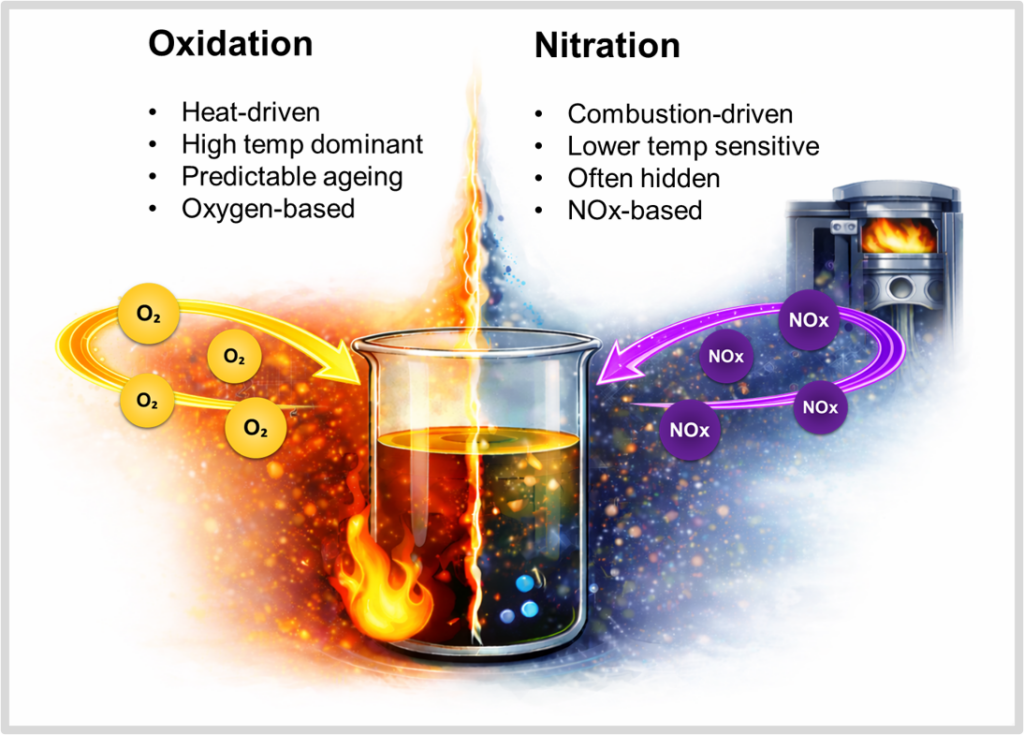
Nitration is far less talked about than oxidation, yet in many engines, it is just as destructive and often more insidious. Unlike oxidation, which is driven by oxygen, nitration is the result of a lubricant reacting with nitrogen oxides (NOx) that are formed during combustion. These gases are produced under the intense heat and pressure inside the combustion chamber and find their way into the oil through blow-by and contact with oil-wetted surfaces.
Put simply, nitration is the chemical reaction between a lubricant and nitrogen oxide gases. Over time, this interaction alters the oil’s chemistry, leading to the formation of nitrogen-containing compounds that degrade both the base oil and additive system. While it shares some similarities with oxidation, nitration follows a different pathway and requires a different approach to detection and control.
Unlike oxidation, nitration occurs in a reduced-oxygen, combustion-driven environment, where nitrogen oxides dominate the reaction process.
In lubricating oils, nitration results in the formation of two primary classes of compounds – organic nitrates and nitro compounds. These species are initially soluble in the oil, but as their concentration increases, they begin to destabilise the lubricant, contributing to deposit formation, oil thickening and the generation of acidic by-products.
As these compounds accumulate, the lubricant’s physical and chemical properties begin to change. The oil may thicken abnormally, acids begin to form, additives are depleted and insoluble materials precipitate out as sludge or varnish. Left unchecked, nitration reduces the lubricant’s ability to protect equipment, increasing the risk of deposits, corrosion and premature component failure.
Nitration is particularly prevalent in gas engines and certain diesel applications, where combustion conditions favour NOx formation. It is also strongly influenced by operating conditions, especially temperature, load and combustion efficiency. Let’s take a closer look at these factors:
The Drivers of Nitration
Nitration is driven by a combination of combustion chemistry, operating conditions and lubricant properties. It begins with the formation of nitrogen oxides (NOx) during combustion, but the extent to which these compounds affect the oil depends on how the engine is operated, how easily gases enter the crankcase, and how resistant the lubricant is to chemical change.
Combustion conditions
Nitration begins in the combustion chamber. High temperatures and pressures break apart nitrogen molecules, allowing them to react with oxygen to form NOx gases. These gases then interact with the oil, especially when combustion is inefficient or unstable. Poor air-to-fuel ratios, uneven combustion, and ignition issues all contribute to increased NOx formation and, therefore, higher nitration rates.
Operating conditions
Operating conditions strongly influence the extent of nitration. Higher engine loads increase combustion temperatures, and NOx production accelerates nitration – even when other variables remain constant. Engines equipped with Exhaust Gas Recirculation (EGR) systems can further increase nitration due to NOx recirculation, while elevated intake-air temperatures and demanding duty cycles amplify the effect.
Mechanical condition
The condition of the engine determines how easily combustion gases reach the lubricant. Worn piston rings, scored liners and poor sealing allow blow-by gases to enter the crankcase, carrying NOx directly into the oil. Poor crankcase ventilation further increases the residence time of these gases, accelerating nitration.
Oil temperature
Unlike oxidation which accelerates at higher temperatures, nitration is often more pronounced at moderate to lower oil temperatures. At lower sump temperatures, nitrated compounds remain stable and accumulate in the oil. At higher temperatures, these compounds can decompose, often feeding into oxidation processes instead. This makes nitration particularly problematic in engines that run cooler or operate under fluctuating thermal conditions.
Oil formulation
The lubricant itself influences its susceptibility to nitration. Base oil type and additive chemistry play a critical role, with more saturated base oils such as polyalphaolefins (PAOs) offering greater resistance. However, some additive systems and viscosity modifiers can actually increase susceptibility, allowing nitration products to form more easily.
What Happens Inside the Oil?
Organic Nitrates
These are the most common nitration by-products. They form on cylinder walls and are washed into the crankcase, where they dissolve in the oil until saturation is reached.
Once that limit is exceeded, they fall out of solution, forming sticky deposits that appear on components such as piston skirts, valve trains and ring zones. These deposits appear as reddish or amber varnish, a classic visual indicator of nitration.
Nitro compounds
Nitro compounds are typically associated with blow-by and combustion gas contamination. Their presence often indicates mechanical issues such as poor ring sealing or combustion inefficiencies. These compounds contribute to abnormal oil thickening and accelerate sludge formation, often appearing alongside severe deposit problems.
Interaction with oxidation
One of the most important – and yet overlooked – aspects of nitration, is its relationship with oxidation.
At elevated temperatures, nitrated species can decompose, generating highly reactive compounds that accelerate oxidation. This creates a compounding effect, where nitration effectively feeds the oxidation process, leading to faster overall oil degradation.
The consequences of nitration
As nitration progresses, its effects become increasingly damaging.
Oil thickening can occur due to the formation of complex nitrogen-containing compounds. Deposit formation leads to varnish and sludge, which impair oil flow, reduce heat transfer and promote component sticking – particularly in piston rings and valve systems.
But perhaps the most important and often overlooked consequence is acid formation.
These nitrogen compounds can react with moisture to form nitrous and nitric acids, increasing the corrosive potential of the oil.
Nitration products can act as precursors to strong acids, which contribute to corrosion and accelerate additive depletion. In some cases, traditional oil analysis indicators such as total base number (TBN) may not fully reflect this effect, making nitration particularly dangerous if not properly monitored. In service, this leads to increased oil consumption, reduced filter life, higher wear rates and a greater risk of unplanned failures.
Detecting Nitration Through Oil Analysis
Nitration is primarily monitored using Fourier Transform Infrared (FTIR) spectroscopy – often referred to as the “fingerprint” test of oil analysis, which detects nitrogen-containing compounds through their characteristic infrared signatures.
However, interpretation requires care. Unlike oxidation, the intensity of these FTIR signals does not always directly reflect degradation severity, as nitration behaviour is influenced by temperature, oil formulation and operating conditions. As a result, nitration is more difficult to assess than oxidation and typically requires a combination of tests to understand its impact fully. The key tests used to assess nitration are summarised below.
Final Thought
Nitration is not always obvious. It does not always present itself with dramatic visual changes early on and its effects can develop unnoticed until deposits, corrosion or performance issues become obvious.
Like oxidation, nitration cannot be eliminated. However, it can be managed effectively through good combustion control, proper temperature management, sound mechanical condition and a robust oil analysis programme.
Understanding nitration and recognising how it differs from oxidation is key to diagnosing oil degradation correctly. In many cases, the oil isn’t just ageing – it’s quietly becoming more acidic long before anyone notices – the acid you didn’t see coming.
Look out for the next instalment in this series, where we explore thermal breakdown – what happens when oil simply can’t take the heat.
Please visit www.wearcheck.co.za or contact WearCheck on marketing@wearcheck.co.za or +27 (31) 700-5460.