


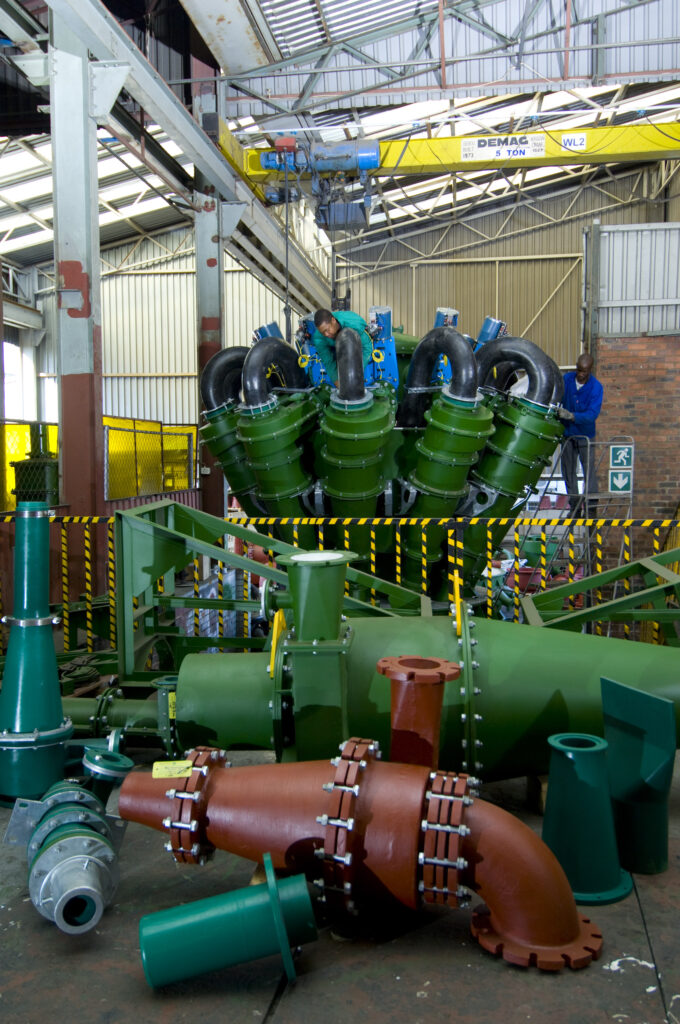
Due to the deceptively simple design of a cyclone, which uses centrifugal forces to separate particles according to a predetermined cut-point, it is easy to underestimate the significant financial losses that can result from poor separation efficiency. Classification is a critical yet often overlooked process in a mineral processing plant. Cyclones play a fundamental role in determining particle size distribution and separation efficiency, influencing downstream recovery, equipment performance, and overall plant productivity.
To help operators better understand why cyclone efficiency matters, Multotec will showcase its Glass Cyclone at Electra Mining Africa 2026. This transparent cyclone will allow visitors to see the classification process in real time, including internal flow patterns, particle behaviour, and discharge patterns. By making the classification process visible, the Glass Cyclone demonstrates the important relationship between cyclone design, wear management and overall plant performance.
Driving mineral processing efficiency with cyclones
According to Ernst Bekker, Process Specialist for Cyclones at Multotec, if a cyclone is not performing optimally, poor separation directly impacts downstream mineral recovery. “In mill circuits, for example, the cyclone ensures that material is appropriately sized for downstream recovery, preventing over-grinding within the mill, leading to unnecessary energy consumption. Providing sub-optimal feed conditions to the mill, in close circuit with a hydrocyclone, also influences the mill efficiency, preventing the mill from performing at optimal conditions. If the cyclone presents too coarse material, via misplacement, to processes such as leaching, the minerals cannot be effectively liberated, leading to suboptimal recovery,” explains Bekker.
Bekker warns against the misconception that cyclones are simply a classification tool. “Many operators assume that a cyclone is functioning correctly simply because material is discharging from both the overflow and underflow. In reality, this can mask poor classification efficiency, which negatively affects both upstream and downstream plant performance,” Bekker says.
Do your cyclones make the cut?
Effective cyclone design starts with determining the required cut-point for the application – that is the particle size at which the cyclone must separate coarse and fine particles.
Bekker explains that once the required cut-point has been established, engineers can determine the number of cyclones required, as well as their diameter, length, and the vortex finder and spigot dimensions, enabling a customised design for each application.
Equally important are the operating conditions in which the cyclones operate. “If the operating pressure is too low, the cyclone cannot achieve effective separation. If it is too high, wear rates increase, energy consumption rises, and component life is reduced,” Bekker notes.
Ensuring ongoing cyclone performance and optimisation
Effective wear management is important to maintaining classification performance. Because cyclone efficiency begins to deteriorate before visible wear appears, such as external leaking, regular inspections are critical.
Bekker recommends quarterly or biannual internal inspections to identify early signs of component degradation and enable proactive maintenance before performance is impacted.
Sensors and instrumentation that measure flow, pressure, vibration and discharge conditions can also support performance monitoring. “These systems monitor key operating parameters and alert operators when performance moves outside the cyclone’s optimal operating range,” he explains.
While instrumentation enables real-time monitoring, sampling remains one of the most reliable methods to verify cyclone performance. “By analysing representative samples from the feed, overflow and underflow, operators can calculate separation efficiency and gain a clear understanding of what is happening inside the cyclone,” says Bekker.
The importance of understanding cyclone efficiency
Inefficient cyclone performance can affect the entire plant value chain, and its impacts are often underestimated.
By understanding how classification inefficiency influences mineral recovery and energy use, operators can prioritise stable feed conditions, correct cut-point control, effective wear management, and performance monitoring to reduce losses and improve overall plant efficiency.
Bekker concludes that cyclone efficiency should never be underestimated, as even small inefficiencies can have significant downstream consequences across the entire processing circuit.