Steel wire ropes at mining industry are subject for the thorough examination to ensure their safe operation throughout their entire service life. Magnetic method of non-destructive testing, based on the MFL principle, is widely used for ropes of different application, including hoisting ropes in mines. INTRON PLUS Ltd. has been engaged in magnetic testing of steel wire ropes since 1991, having started a project to develop magnetic flaw detectors for mine hoisting ropes. Magnetic method significantly enhances the possibilities of obtaining information about the rope, namely: a) detection of local flaws (LF) such as external and internal wire breaks caused by fatigue due to repetitive bending of rope over sheaves and drums, as well as
- b) measurement of loss of metallic cross-sectional area (LMA) resulted by corrosion, abrasion i.e. missing of steel from wire surface. Due to physical principle of magnetic method of non-destructive testing, the rope being tested should be magnetically saturated for proper inspection. This requirement is clearly stated in relative national and international standards on magnetic rope testing (MRT).
MRT instrument INTROS developed by INTRON PLUS, is equipped with power magnets for magnetic saturation of ropes, and sensitive sensors to simultaneously reveal LFs and measure LMA at speed up to 4 m/s. The INTROS is capable to inspect ropes from 6 to 165 mm in diameter. Wintros software allows the operator to significantly speed up the interpretation of inspection results and generate test report. Customers in over 60 countries use the INTROS: Bridon, DMT, Kiswire, Anglo-American, Arcelor Mittal, Tokyo Rope, Tata Steel, Konecranes, Codelco, Rolls-Royce, De Beers, etc.
INTROS is manually installed on the rope before testing and removed from the rope after testing. Interpretation of data requires qualified personnel and thus takes some time to issue inspection report. If inspection and interpretation were performed automatically, downtime of the mine hoist, required for manual inspection, could be avoided, and the rope test report would be immediately available.
Thus, the next step towards increasing rope safety and productivity of hoisting operations was development of the automated rope condition monitoring system INTROS-AUTO. The system can automatically inspect steel ropes with diameters from 6 to 150 mm at speed of up to 5 m/s. The INTROS-AUTO operates MFL principle, i.e. magnetically saturates the rope for inspection, and is dual-function system capable of detection outer and inner LF, including calculation of number of broken wires at a certain rope length, as well as accurate measurement of LMA. The technical condition of ropes is assessed by two criteria: the number of broken wires over a given rope length and the percentage of loss of metallic cross-section. Rope rejection criteria can be customized by the customer. Both the inspection and data interpretation are carried automatically without human intervention, i.e. qualified inspector is not required on-site for assessment of actual technical condition of rope. The operator of the hoist can start measurement at any time. Rope monitoring with the INTROS-AUTO reduces downtime of the hoist for manual MRT, as well as simplifies and speeds up data interpretation, so inspection results automatically appear in a few seconds after rope examination is over.
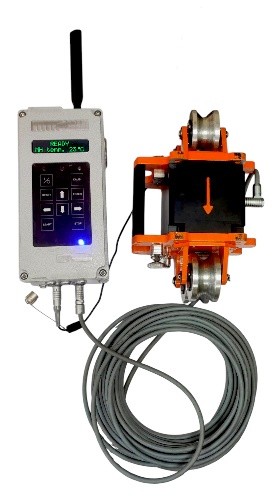
The INTROS-AUTO consists of control and display unit (CDU) and magnetic head (MH) interconnected with special rugged noise-immune cable up to 400 m in length (fig. 1a). For inspection of mining ropes permanent installation of MH on the rope is recommended (fig. 1b). The system has explosive proof design and meets requirement of IP66 to operate in harsh environment at ambient temperature from -40° C to +50° C under rope speed up to 5 m/s.
In case of multi-rope hoist, each rope is equipped with the separate MH. The CDU is located at the workstation of the operator of the mine hoist, so the operator can observe the results of inspection on the screen of CDU in the real time mode. Besides, data may also be viewed on a PC, connected to CDU. Special multifunction software delivered with the INTROS-AUTO, processes data during inspection and immediately interprets data right inspection is finished. The INTROS-AUTO system can be implemented into the external computer network.
The CDU indicates rope condition in a traffic light manner “green-yellow-red” that enables the responsible personnel to continue rope operation or take the necessary actions.
Although the system automatically interprets the results, all test data stored in the CDU memory chip and is available for manual review if necessary. The CDU can be connected to the computer via cable or WiFi Internet and further be incorporated into the network of the enterprise, thus inspection data are available remotely to the management. Inspection of ropes is carried out at regular intervals, say once a shift.
The automated rope condition monitoring system INTROS-AUTO already successfully operates at mining hoists, cranes, and drilling rigs. The use of the INTROS-AUTO allows automatic receipt of information on the rope condition at any time and consequently improves safety of hoisting operations. Furthermore, rope monitoring increases productivity of hoisting operations by reducing downtime of hoist equipment for manual rope inspection.