


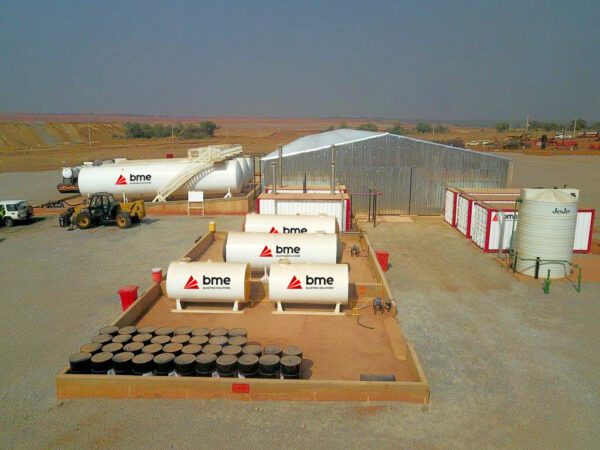
BME, an Omnia Holdings company, has engineered modular, containerised emulsion plants that help address the logistical and supply chain challenges faced by remote mines by providing a secure, reliable supply of explosives on site.
Dirk Voogt, Production and Logistics General Manager at BME, said traditional explosive supply models in regions such as West Africa and remote southern Africa face pressure from long distances, fragile logistics chains, fluctuating demand, and strict safety and environmental regulations.
“Our on-site modular emulsion plants provide a secure, continuous and independent supply of high-quality blasting explosives while significantly reducing the need to transport higher-risk Class 1 products over long, hazardous distances,” he said.
Most of the raw materials used in the plants are classified as Class 5.1 oxidisers. “The emulsion only acquires the detonation potential similar to a true Class 1.1 explosive once it is chemically sensitised and pumped into the blast hole,” he explained. “This fundamentally changes the risk profile of the supply chain and removes the need for high-security magazine facilities for finished blasting material on site.” On-site production also reduces the risk of product contamination that can occur during long-distance transport.
Rapid deployment and flexible capacity
Voogt said the plants draw on more than 40 years of engineering development. “Built into standard shipping containers and supplied with all required assembly tools, they can be unpacked and commissioned rapidly even at isolated sites,” he explained.
The self-supporting containerised modules can be installed on compacted hardstands or basic concrete plinths rather than extensive reinforced concrete structures. “Utilities connect through predefined interfaces, so site preparation can run in parallel with plant fabrication,” Voogt noted. “This shortens project timelines and reduces construction risk at remote sites where specialist contractors and quality materials are often scarce.”
Capacities range from 20 tonnes of emulsion in an eight-hour shift to more than 40 tonnes, allowing plants to be matched to a mine’s production profile. “Preassembled and factory-tested modules deliver predictable commissioning and a rapid ramp-up to nameplate production capacity,” he said. “The modular design also allows capacity to be scaled by adding modules as operational demand grows.”
When mine layouts change or new projects start, the plants can be dismantled, moved on standard flatbed trailers and redeployed at far lower cost and with less disruption than fixed facilities. “Standardised modules ensure consistent maintenance, spares and control systems across the fleet,” he added.
Safety, performance and sustainability
Voogt said that safety and process integrity are engineered in from the start. “Multiple layers of process safety – including redundancy on flow and pump systems, mechanical safeguards including world class pump safety protection including electronic as well as mechanical safety trips, such as bursting discs, and rigorous HAZOP studies – mirror the standards applied at BME’s stationary facilities,” he said.
Automated digital process control and historian capability further reduce operator dependence and provide full traceability. “The plants can also produce BME’s high-viscosity dual-salt formulations, including INNOVEX 300™ which is designed to perform reliably in dynamic water and variable ground conditions,” he noted.
The plants can process used oil as a fuel agent, supporting circular economies and progress toward mines’ ESG targets. “On-site manufacturing shortens transport distances, cuts the carbon footprint of long-haul logistics, and creates opportunities for local sourcing of raw materials and community-linked SME development,” he said. “Structured training and digital learning materials further build local technical skills.”
Operating across Africa
Voogt reported that BME has deployed these systems successfully in some of Africa’s most demanding environments, including Mali, Mauritania, Burkina Faso, Sierra Leone, the Democratic Republic of Congo and Angola. “In each case, they have operated reliably under extreme temperatures, dust-laden atmospheres, limited infrastructure and constrained specialist support,” he said.
The modular plants integrate with BME’s broader blasting ecosystem, namely INNOVEX™ emulsions, AXXIS™ electronic initiation systems, digital tools such as XPLOLOG™ and XPLOCHARGE™, and mine-to-mill optimisation solutions. “This allows customers to align product formulation, blast design and downstream processing for measurable gains in fragmentation, recovery and energy efficiency,” he said.
In an environment where agility, resilience and responsible performance are non-negotiable, the modular plants turn a traditional supply challenge into a lasting competitive advantage. “This gives mines greater control, lower logistical risk and a stronger foundation for long-term productivity,” he concluded.