


CUPANI Metals Corporation is pleased to announce its 2025 fieldwork program on its Copper-Nickel-PGE Blue Lake project in the southern part of the Labrador Trough in Quebec. Field work began in late June. The project contains several magmatic Cu-Ni-PGE deposits and occurrences in the form of disseminations in peridotite and pyroxenite, as well as remobilized massive sulphide lenses at the contact of metasediments and overlying ultramafics.
The field team is made up of members of CUPANI with support from Kintavar Exploration Inc. The Retty camp, located at the center of the property, is used as the base camp for the season.
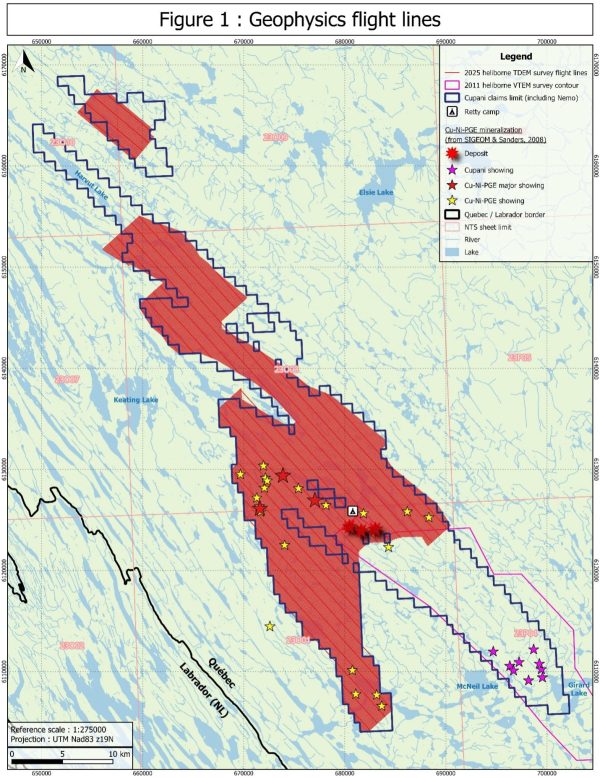
CUPANI contracted Expert Geophysics Surveys Inc. to conduct a heliborne magnetic-electromagnetic survey (TDEM). The survey will cover most of the main claim block comprising the historical showings and the Blue Lake zone deposits to extend and update the coverage of the 2010-2011 surveys. This new survey will provide high quality data on a day-to-day basis to the field crew for target verification and subsequently for geophysical modelling in preparation of next winters drilling. The survey is planned for 5313 line-km and covers claims recently added to the Extensions Zone. Expert Geophysics Surveys Inc. are currently onsite having started the survey on July 17.

Blue Lake zone
Historical deposits of Copper-Nickel-Platinum-Palladium sulphide mineralization were discovered and outlined in the Blue Lake zone between the 1950’s and 1980’s through drilling and underground exploration via an adit at Blue Lake. Previous operators reported historical resources of 4.37 million tonnes (metric) at 0.87% Cu, 0.52% Ni and 0.84g/t Pt+Pd for 2.28% copper equivalent (not NI 43-101 compliant). Most of the mineralized zones are still open along strike and at depth. Several new similar targets were identified from the 2024 ground gravity survey over the Blue Lake zone.
Anticline Lake zone
Rusty outcrops and mineralization is observed over more than 25 kilometres strike length in the Anticline Lake zone. In 2024, grab samples taken from the historical showings and along their extensions yielded values between 0.1 and 0.5% Cu with Ni and PGEs values up to 0.3% Ni and 0.5 g/t PGEs. The results in copper equivalencies range up to 1.1% Cu-Equi. Being less explored and drilled than the Blue Lake zone, the Anticline Lake zone has good potential of finding enriched massive sulphides lenses.
Cancun zone
The mineralized rocks in the Cancun zone are mostly hidden under soil and vegetation cover of less than 1 meter depth. Local small manmade trenches were dug to expose and sample the bedrock mineralization. Copper mineralization was identified in massive to semi-massive sulphides and traced for over more than 9 kilometres along strike. The mineralisation is coincident with electromagnetic anomalies along the southern fold hinge. Cancun zone grab samples yielded values between 0.1 and 0.6% Cu-Equi., with one sample up to 1% Cu. Additionally, a grab sample taken on the eastern limb of the fold returned a gold value of 1.93 g/t Au, which needs further investigation.
Moreover, where a NE trending regional fault crosscuts the Cancun fold mineralization was identified over 150-metre strike length. This returned the highest copper value of the 2024 program, namely 0.9% Cu from one sample. That find is coincident with an electromagnetic anomaly in the area where several anomalies are yet to be investigated.
Doublet and Extension zones
Both zones were staked in summer 2024 based upon prospective peridotite sills, and high copper concentrations in lake bottom sediment samples reported by the Quebec government. The Doublet zone includes several historical showings of copper-nickel that will be investigated in 2025.
Scientific and technical information contained in this news release has been reviewed and approved by Pierre-Luc Lalonde who is a “qualified person” under NI 43-101 for Blue Lake project in Québec (OGQ permit 01920).